Understanding how to properly measure your roof is very important for homeowners looking to carry out repairs, replacements, and inspections. Roof measurement is important because it directly impacts any material estimation, labor costs, and the overall success of any roof project. By measuring your roof accurately, you can avoid expensive mistakes, enjoy peace of mind when carrying out roofing projects, and feel confident about your choices when hiring roofing professionals. In this ultimate guide, we cover everything homeowners need to know about roof measurement techniques, tools, calculations, and hiring a professional service.
Table of Contents
Why Roof Measurement Matters for Homeowners
Roofs are a big investment. Just like any home improvement or construction project, the correct and accurate dimensions of your roof affect every stage of the project. Correctly measuring your roof can help ensure:
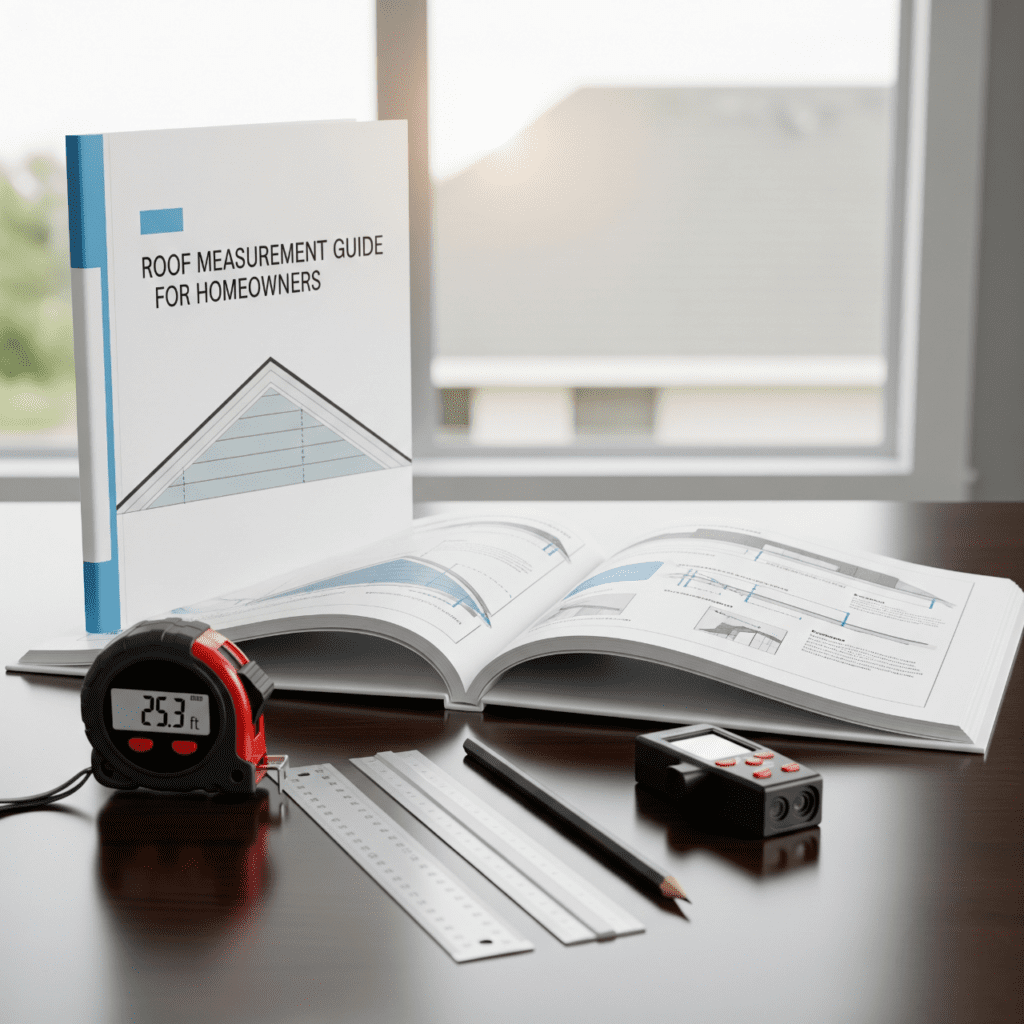
- Proper quantities for your material estimates – keep you from buying too much or not enough.
- Accurately, appropriately, and fairly priced project estimates for contractors.
- More efficiency during the project – saving you time and, best of all, waste.
- Improved safety – by reducing unnecessary trips up the roof or inspections.
Even if you are not doing inspections yourself and utilizing professional trades, knowing how to measure your roof provides you peace of mind that you are acquiring work at a correct and reasonable cost.
Key Terminology for Roof Measurements
Before working on roof measurement techniques, let’s cover some roofing terminology that every homeowner should be familiar with:
- Roof Square – The standard measurement for roofs. One roof square equals 100 square feet.
- Pitch/Slope – The steepness of a roof, expressed as a ratio (like 6/12 meaning a roof will rise 6 inches for every 12 inches of run).
- Ridge – The high point in the area where two planes of the roof meet.
- Eave – The edge of the roof that hangs over the walls.
- Valley – The internal angle of the two sections of the roof.
Becoming familiar with these terms will help you communicate effectively with professionals in the roofing industry.
Methods to Measure Your Roof
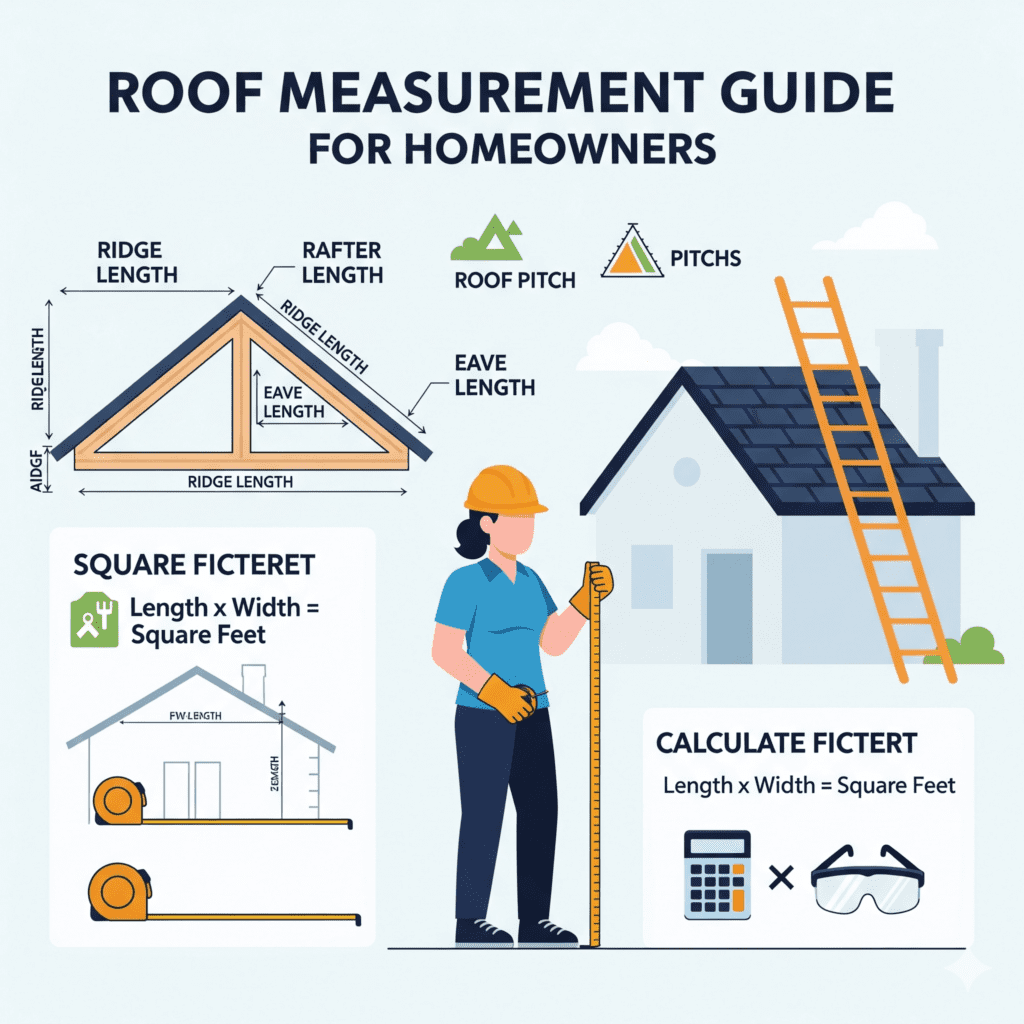
- Manual Roof Measurement
The most traditional way is to get on the roof and use basic measuring tools (tape measure, chalk line, ladder). The process is as follows:
- Measure the length and width of each section of the roof.
- Multiply the length and width together to get the area of each plane.
- Add the area of the final sections together to get the total area of the roof.
- Adjust for the pitch factor on the roof (steeper roofs will have more surface area).
This method is nice and accurate, but it can be dangerous, and you need climbing equipment to get on the roof in the first place.
- Ground-Based Estimation
If you’re not comfortable climbing, you can measure from the ground using the blueprints of your home or measure the exterior walls. Then you may need to use the pitch of the roof to estimate the total square footage. While this can be less accurate, it can also be much safer for the homeowner.
- Aerial and Satellite Roof Measurement
Modern technology has taken roof measuring to a whole other level. Using satellite imagery and aerial photos, custom software can measure roofs with a high degree of accuracy. Benefits include:
- No physical risk – no climbing is necessary.
- Daily reports – reports are generated within hours.
- Detailed reporting – The reports give you all of the information including slopes, ridges, valleys, and edges.
This technology is used by roofing contractors and insurance companies to provide accurate estimates.
How to Calculate Roof Pitch and Surface Area
Step 1: Discover Roof Pitch
- Place a level on the roof horizontally.
- Measure the vertical rise over a 12-inch horizontal run.
- Example: If the rise is 6 inches over 12 inches, that would give a pitch of 6/12.
Step 2: Apply Pitch Factor
Use the pitch to adjust surface area. Examples of pitch factors are:
4/12 pitch = 1.054
6/12 pitch = 1.118
8/12 pitch = 1.202
10/12 pitch = 1.305
Step 3: Calculate Roof Area
- When measuring each roof section measure length × width.
- Add all of them together to get total ground area.
- Multiply the total ground area X pitch factor to arrive at the actual roof surface area.
Common Mistakes Homeowners Make in Roof Measurement
- Failing to take pitch into account, leading to underestimated material.
- Not being careful with little areas, like dormers or extensions.
- Misunderstanding blueprints when there is no adjustment for pitch.
- Throwing away roof overhangs can add a significant amount of square footage.
Avoiding the mistakes above will save money and ensure the job is accurate.
Tools That Simplify Roof Measurement
Modern homeowners have access to tools that expedite roof measurement:
- Laser measuring devices – quickly calculate distances.
- Roof pitch calculators – apps for the smartphone.
- Aerial measurement services – detailed reports with exact measurements.
- Roofing calculators – online for quick estimates.
Professional Roof Measurement Services
For homeowners who want accuracy above all else, professional roof measurement services are the gold standard. These services might utilize satellite imagery or sophisticated CAD software to provide comprehensive reports that can include:
- Total roof area (in squares and square feet).
- Pitch and slope diagrams.
- Linear measurements of ridges, hips, and valleys.
- A waste factor recommendation.
Professional reports not only assist with estimating materials, but they bolster insurance claims, as well as negotiations with contractors.
Why Hire a Professional Instead of DIY?
Do-it-yourself measures may save a few dollars, but the right service can give you:
- Precision – removing guesswork.
- Safety – you don’t need to climb up ladders or other things that could cause a fall.
- Efficiency – professional could probably write the report in a fraction of the time it took to do the measuring.
- Credibility – Contractors will trust professional measurements for their bids.
If you have complex or large roofs, professional services would come highly recommended.
Cost of Roof Measurement Services
Prices will vary by the service:
- Manual contractor walkthrough inspection – $100 -$300
- Drone measurement – $150 – $400.
- Satellite/Aerial reports – $50 – $150.
All things considered, accuracy and convenience make professional services worth the cost for most homeowners.
Conclusion
The measurement of the roof is the basis of a successful roofing project. Whether you choose to use manual methods or satellite-based reports, accurately determining the scope of work is the first step to saving time, money, and ultimately ensuring the successful completion of your project. Now, as a homeowner, you want to know something about roof measurements, as they will guide your decision-making and contracting experience.
(FAQs)
1. What is the simplest way to measure my roof?
The simplest way to measure your roof is to use aerial or satellite roof measurement services that provide precise dimensions so you do not have to use a ladder to measure your sloped roof. If you prefer to do it yourself, the easiest way is to measure the ground area (length multiplied by width) and then multiply by the pitch factor.
2. How do I find the square footage of my roof?
To find square footage of your roof, you measure each section of the roof for length and width, then multiply the two lengths to find the area. After that, you add all the sections together, and multiple that total square footage by a pitch factor to account for the roof slope.
3. What is a roof square?
A roof square is the unit of measurement used in roofing, that equals 100 square feet. So, say your roof was 2,000 square feet, that would be 20 squares.
4. In roof measurement, why does roof pitch matter?
Roof pitch is important because it significantly affects the surface area of your roof. In general, a straight flat area on a roof has less surface area than sloped areas, and that will determine how much covered material you will need for your roof.
5. Can I measure my roof without climbing?
Yes, in addition to aerial or satellite measurement, drone technology can be used. A safer method is to use blueprints to estimate from ground level. In all 3 methods, you are not putting yourself at risk climbing on a roof, and it possibly provides a more accurate measurement.
6. What is the accuracy of satellite roof measurements?
Satellite roof measurements are usually 95% to 99% accurate and are considered one of the best ways for contractors and homeowners to measure a roof.
7. How much does professional roof measurement cost?
It’s a huge range from $50 to $400, and it depends on using satellite reports, drone inspections, or contractor services for measurement.
8. Do I need a professional roof measurement before replacing a roof?
Yes. Professional measurement provides accurate measurements of materials and labor costs, preventing you from overpaying for supplies or services.
9. What tools can I use to measure the roof myself?
You can use a tape measure, laser measuring tool, a roof pitch calculator or simply roofing apps to measure your roof at home.
10. What will roof measurement do for insurance claims?
Yes. Professional roof measurement reports provide verified documentation of the size, condition, and structure of your roof, which will significantly strengthen your insurance claims.