
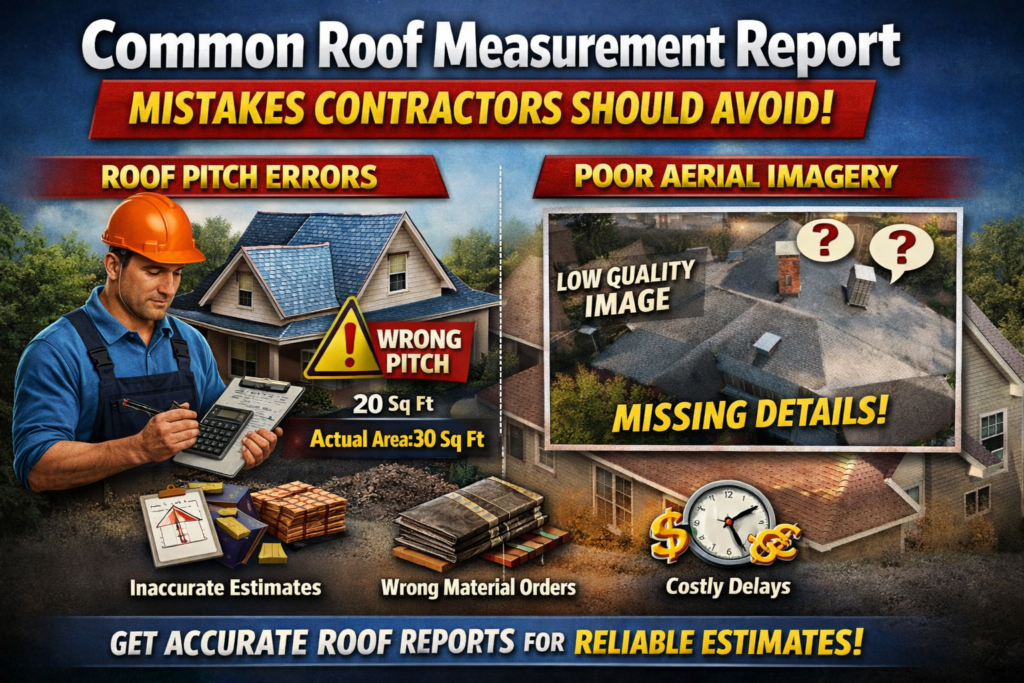
Accurate roof measurement reports are essential for preparing reliable roofing estimates.
Contractors rely on these reports to understand roof dimensions, slope, and structural features
before ordering materials or scheduling labor.
Across roofing markets in the USA, Canada, the UK, and Australia, many contractors use
aerial roof measurement services to speed up estimating and reduce site visits. However,
reports can still become inaccurate when roof pitch is miscalculated or aerial imagery is poorly
analyzed.
Understanding these two issues helps contractors avoid delays, incorrect material orders, and
unreliable roofing estimates.
Roof Pitch Calculation Errors in Roof Measurement Reports
Roof pitch determines the steepness of a roof and directly affects the true roof surface area. A
common mistake happens when roof measurements are calculated only from the building
footprint. While the footprint shows the size of the structure on the ground, it does not represent
the real roof surface.
Most roofs include slopes, ridges, hips, valleys, and multiple sections. Because of this, the actual
roof area is usually larger than the footprint measurement.
If roof pitch is calculated incorrectly, contractors may underestimate materials and produce
inaccurate roofing estimates. Professional roof measurement report solve this problem
by calculating pitch for each roof section and applying proper pitch factors to determine the real
surface area.
Poor Aerial Roof Imagery Analysis
The accuracy of a roof measurement report also depends heavily on the quality of aerial imagery.
Aerial imagery provides a top-down view of the roof and helps identify the entire roof layout.
When imagery is outdated or unclear, important roof structures can easily be missed during
measurement.
These may include chimneys, skylights, vents, dormers, and complex roof planes. Missing these
details can affect the final roof measurements and material calculations.
Modern aerial roof measurement technology uses high-resolution imagery and mapping tools
to capture every roof section clearly. This allows contractors to generate detailed roof diagrams
and prepare accurate roofing estimates.
Why Accurate Roof Measurement Reports Matter
Reliable roof measurement reports allow contractors to estimate projects faster and with greater
confidence. When roof pitch and aerial imagery are analyzed correctly, contractors gain a
complete understanding of the roof before work begins.
Accurate reports help contractors:
- Measure the true roof surface area
- Identify complex roof sections and structures
- Create clear roof diagrams
- Prepare reliable roofing estimates
- Plan materials and labor efficiently
For contractors working in competitive roofing markets such as the United States, Canada, the
United Kingdom, and Australia, dependable measurements can significantly improve
estimating accuracy.
Conclusion
Most mistakes in roof measurement reports occur because of incorrect roof pitch calculations or
poor aerial imagery analysis. Ignoring roof slope or missing structural features can quickly lead
to inaccurate estimates.
By using professional aerial roof measurement services and high-resolution imagery,
contractors can generate dependable roof reports, improve estimating accuracy, and complete
roofing projects more efficiently.