Understanding how do you calculate roof pitch is an important factor for many professionals involved in roofing, such as roofing contractors, roofing estimators, architects and homeowners. Roof pitch has an impact on the roofing material selection, drainage performance, cost of roofing labor, safety, planning and the ability to comply with building codes. This professional and easy-to-use guide provides roof pitch calculation methods that generate reliable results without needless complexity. The guide provides step-by-step instructions for calculating roof pitch using three simple steps with real-life examples, practical tips and application for roofing contractors.
Table of Contents
What Is Roof Pitch?
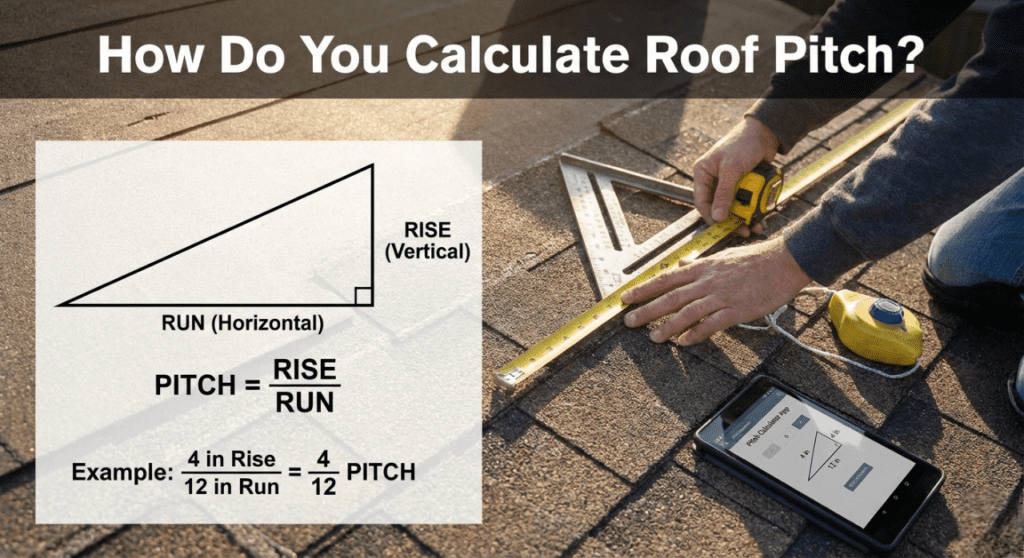
Roof pitch is the angle or slope of a roof to its overall length, usually expressed as a ratio between the amount of vertical rise to a certain distance over which that rise occurs (known as horizontal run). Roof pitches used in North America are typically written in terms of an upward number (X) divided by 12. This means that the upward measurement should represent how far the roof rises up for every foot (12″) of distance from the point at which it begins to rise.
Examples include:
- 4:12 (4) means that for every one foot of distance along the bottom of the roof, the roof rises four inches vertically.
- 5:12 (5) means that for every one foot of distance along the bottom of the roof, the roof rises five inches vertically.
Knowing how do you calculate roof pitch will help you get everything measured correctly for purchasing supplies, estimating your costs, and creating safe working conditions.
Why Accurate Roof Pitch Calculation Matters
Correct pitch calculation directly impacts:
- Compatibility of roofing materials
- Weather Resistance and Water Drainage
- Calculations / Load Capacity of Structural Design
- Safety and Labor Time Requirements
- Accuracy of Cost Estimates/Job Quotes
Pitch’s Failure to Measure Can Result in Waste, Improper Installation, and Non-Compliance with Codes. Therefore how do you calculate roof pitch is a Basic Roofing Skill to Be Learned.
Tools Required to How do you Calculate Roof Pitch
Before starting, gather these basic tools:
- Measuring tape
- 24-inch or 12-inch level
- Pencil or marker
- Calculator (optional)
These simple tools allow accurate pitch measurement without specialized equipment.
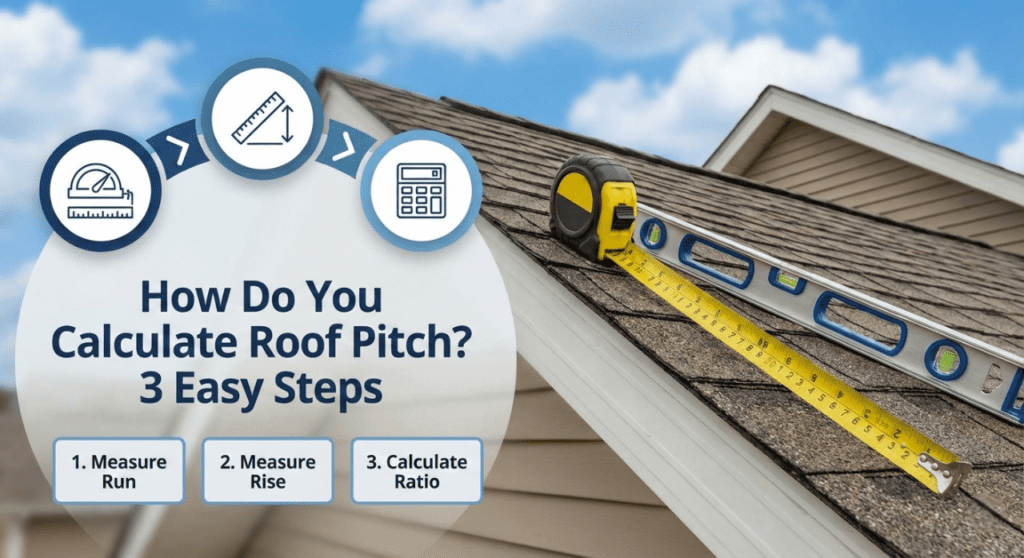
How Do You Calculate Roof Pitch? Step-by-Step Guide
Step 1: Measure the Roof Run
The run is the distance measured along the horizontal line that forms the base of the roof pitch. The standard value of the run is 12 inches (in). After levelling and checking to make sure your level is level, mark the bottom of each side of your level at 12 inches from one end. This gives you a fixed point on how do you calculate roof pitch from, thus providing a common reference for all roofs.
Step 2: Measure the Roof Rise
When measuring the vertical distance between the bottom of your level and the top surface of the roof, keep the level flat. At the 12-inch mark of the level, measure straight down vertically from the roof surface until you reach the bottom of your level.
This vertical distance would be defined as Your Rise.
EXAMPLES:
- Your vertical distance = 6 inches – Therefore, your pitch = 6:12
- Your vertical distance = 9 inches – Therefore, your pitch = 9:12
- That’s it! You have now calculated your roof pitch!
Step 3: Express the Pitch Ratio
Write the pitch as rise:12.
Examples:
- 4-inch rise → 4:12 pitch
- 7-inch rise → 7:12 pitch
- 10-inch rise → 10:12 pitch
This standardized format is used by roofing suppliers, contractors, and building inspectors nationwide.
Roof Pitch Calculation Examples
An Example of a Low Slope Roof
- Rise = 2″
- Run = 12″
- Pitch = 2:12
Low Slope roofs are often used on commercial buildings and newer style homes.
An Example of a Medium Slope Roof
- Rise = 6″
- Run = 12″
- Pitch = 6:12
Medium Slope roofs are used in residential roofing systems because they offer greater drainage capability and allow people to walk on the roofs.
An Example of a Steep Slope Roof
- Rise = 10″
- Run = 12″
- Pitch = 10:12
Steep Slope roofs are used primarily in snowy climates, or where an architectural design calls for the rapid removal of water.
How Do You Calculate Roof Pitch Without Climbing the Roof?
Access to the roof is not always easy or possible, and in this case you may use interior measurements to determine the pitch of the roof.
To determine how do you calculate roof pitch using the attic method:
- Measure 12 inches horizontally along a rafter from the inside of the building.
- Measure how far vertically from that position to the roof deck.
- The pitch will be expressed as a rise:12 ratio.
- This attic method is commonly employed by inspectors and estimators where there is limited or no access to the outside of the building.
Converting Roof Pitch to Degrees
There are some engineering designs that use pitch in degrees instead of ratios.
To calculate pitch in degrees use this formula:
Degrees = arctangent (Rise / Run)
Example:
- To find the degree measurement for a 6 to 12 pitch use arctangent (6 / 12) = 26.6 degrees.
Conversion to degrees from pitch ratios can be helpful on architectural drawings, solar panel installations, and performing more advanced structural analysis.
Roof Pitch Categories Explained
Flat Roofs
- 0:12 to 2:12 Pitch
- Special Membranes can be used to promote drainage from this type of roofing.
Low-Slope Roofing
- 2:12-, 4:12 Pitch
- This type of roofing often uses modified bitumen or metal panels.
Conventional Roofs
- 4:12-9:12 Pitch
- Asphalt shingles are typically used on this type of roofing.
Steep-Slope Roofing
- Above 10:12 Pitch
- These types of roofs require workers to wear safety harnesses and be trained in the use of specialized equipment.
By reviewing the above categories, the how do you calculate roof pitch can be used for practical decision-making for building construction.
Common Mistakes When Calculating Roof Pitch
- Measuring run incorrectly
- Forgetting to keep the level horizontal
- Using metric and imperial units together
- Estimating visually without measurement
Professional accuracy depends on consistent methodology.
How Do You Calculate Roof Pitch Affects Roofing Materials
Different roofing material types have minimum pitch ratings; some of them are shown here.
- Asphalt Shingled Roofing minimum pitch is 2:12.
- Metal Roof minimum pitch is 1:12 (based upon profile).
- Clay Tile minimum pitch is 4:12
- Slate Roof minimum pitch is 6:12
Correctly how do you calculate roof pitch will help avoid material failure and issues with warranties.
Roof Pitch and Drainage Performance
Steeper roofs:
- Allow for faster runoff of water
- Minimize risk of ice dams
- Are better during heavy rains
Flatter roofs:
- Requires additional waterproofing
- Requires accurate installation to prevent pooling
- Therefore, it is important to know how do you calculate roof pitch for climate-specific roof systems.
Roof Pitch and Cost Estimation
Pitch directly influences:
- Labor hours
- Safety equipment needs
- Waste factor
- Installation complexity
Higher pitch = higher labor cost. Accurate pitch calculation ensures precise project bids and profitability.
Professional Roofing Applications
Calculating roof pitch is critical for:
- claims against homeowners’ insurance
- measurements for roofing
- solar panel layouts
- GOINTER systems
- structural engineering reviews.
High-quality, precise measurements can help your company build a credible reputation and improve the operational efficiency of your business.
Best Practices for Accurate Roof Pitch Measurement
- Measure various sections of the roof.
- Carefully document measurements.
- Check your measurements using a secondary method.
- Use the same type of tools for measuring.
Professional estimators have established guidelines for how do you calculate roof pitch accurately.
Final Thoughts on How to Calculate Roof Pitch?
Professional roofers can use the knowledge of how do you calculate roof pitch when creating accurate estimates, safely installing roofs, and complying with building codes. As a roofing professional, following these three simple steps to quickly and accurately calculate roof pitch can help you improve both your efficiency and professionalism throughout every aspect of your roofing business.
FAQs
1: How Do I Calculate Roof Pitch?
You will be able to calculate the pitch of a roof by measuring how many vertical inches of rise a roof has in a 12-inch horizontal (flat) distance. This measurement is then expressed as a ratio, so if there is a 6 inch rise over 12 inches you would say the roof has a pitch of “6 to 12 or 6:12”.
2: What Tools Do I Need to Calculate Roof Pitch?
To calculate the pitch of a roof you will need the following tools: A level, a tape measure and some form of a pencil. A calculator (on your phone or a regular calculator) may also help in calculating the pitch into degrees if needed.
3: Can I Calculate Roof Pitch Without Going on the Roof?
Yes, you can calculate the pitch of a roof by measuring from inside the attic. You will take the same measurements (a rise over a run). The only difference is you will take the measurement on the rafter rather than on the pitch of the roof itself.
4: What is a Good Pitch for shingles?
Asphalt shingles will work best when used on roofs that have a pitch between 4:12 and 9:12 for drainage and longevity.
5: Is Roof Pitch the Same As Roof Slope?
Roof pitch and roof slope are related in that pitch is expressed as a ratio (X:12) while slope is normally expressed as a percent or degree of angle.