Here’s something most homeowners find out the expensive way. Materials get ordered, half get used, and the rest sits in the driveway because the report everyone trusted was never actually checked.
That’s the part nobody talks about enough.
A roof measurement report looks official the moment it’s handed over. A total square footage, maybe a diagram, a number that feels final. But a rough visual estimate can look exactly as polished as a precise one, and the only way to tell the difference is to actually look closer before any money moves.
A clean-looking PDF doesn’t mean an accurate measurement. It just means someone formatted it nicely.
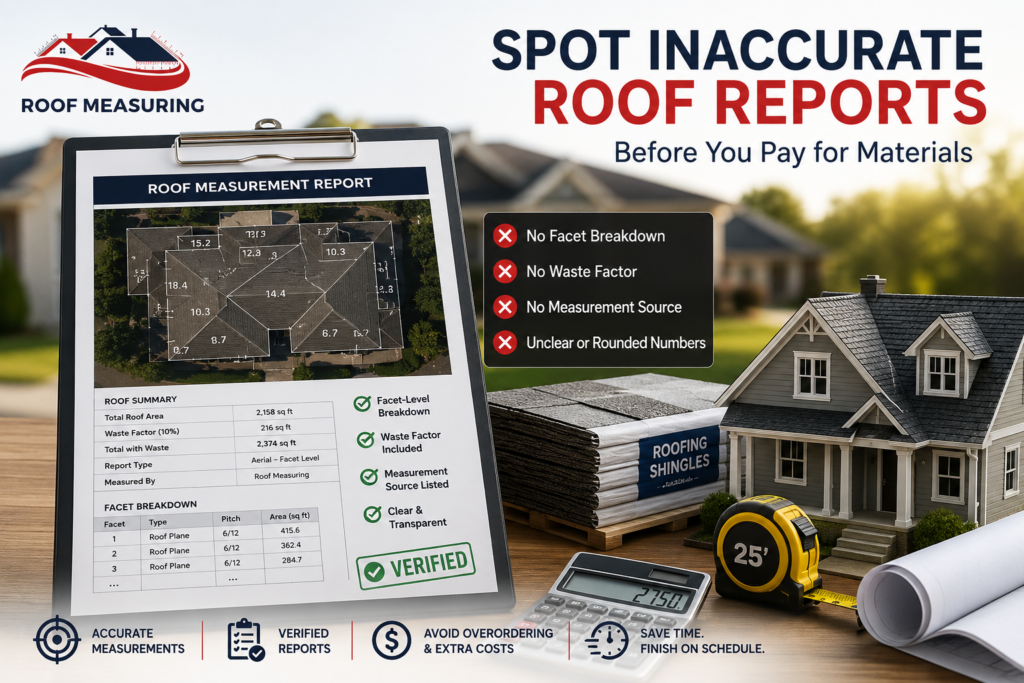
That’s the reality homeowners and contractors both run into eventually. A report with no facet breakdown, no stated waste factor, and no listed measurement source can still hand you a confident-sounding total, one that’s wrong by enough to matter once materials are ordered.
The shift happening right now among homeowners working with contractors is straightforward. Instead of accepting a single blended number at face value, they’re asking for facet-level roof measurement reports that break down every ridge, valley, hip, and slope individually, so the total can actually be checked.
That single question turns a number you have to trust into a number you can verify.
Think about what that means once a material order goes in. The homeowner who never asked for a breakdown finds out the roof was under-measured only when the crew runs short mid-job. The homeowner who confirmed facet detail and waste factor upfront never gets that call.
In a roofing project, that difference isn’t minor. The order built on a verified, transparent report is the one that finishes on schedule, not the one that stalls waiting on a second material delivery.
There’s a cost angle here that’s easy to overlook until it happens. An inflated square footage number doesn’t just get caught eventually, it often gets paid for first. Contractors ordering materials off an unverified report may order too much, and homeowners end up covering the extra cost of shingles, underlayment, and disposal fees for material that was never needed. Checking the roof measurement accuracy upfront isn’t just about avoiding delays, it’s about not paying for a mistake that was preventable before the first pallet of shingles was ever delivered.
And then there’s the source side of this, which honestly gets overlooked. A report that doesn’t say whether it came from aerial imagery, satellite data, or someone’s tape measure gives you no way to judge how much to trust it in the first place. Verified aerial measurement removes that guesswork by showing exactly where the numbers came from.
Homeowners who avoid material overruns aren’t getting lucky. They’re checking the report before they pay.
When a roof measurement report includes facet detail, a stated waste factor, and a clear source, everything downstream gets more predictable. Fewer surprise second orders. Fewer arguments over who measured what. Fewer projects that run long for reasons nobody can explain.
Our aerial roof measurement reports include full facet-level roof area, pitch, ridges, hips, valleys, rakes, and eaves for every property, verified before delivery, with coverage across the USA and Canada and turnaround measured in hours, not days.
If a roof report ever feels like a number you’re being asked to trust rather than one you can check, that’s the moment to ask for the breakdown. Confirm that, and the rest of the project is a lot more predictable.
Visit roofmeasuring.com and get a verified, facet-level roof measurement report before your next material order goes in.