7 Things Insurance Companies Check in a Roof Measurement Report Before Approving Your Claim
Roof measuring is one of the most critical steps when filing an insurance roof claim. Before approving any payout, insurers carefully review your roof measurement report to verify the size, structure, and scope of the damage.
This guide covers exactly what insurance companies look for — and how accurate aerial roof measurements can help you get your claim approved faster.
Table of Contents
- Why Roof Measuring Matters
- Total Roof Area
- Roof Pitch & Slope
- Ridge, Hip, Valley & Eave Measurements
- Roofing Squares
- Roof Diagrams
- Damage Documentation
- Common Reasons Claims Get Delayed
- What to Do Before Filing
Why Roof Measuring Matters for Insurance Claims
A professional roof measurement report gives your insurance adjuster the verified data they need to evaluate your claim fairly and quickly.
Without accurate roof measuring data, it’s difficult to determine material quantities, labor costs, the extent of damage, and the total value of your insurance roof claim. Accurate measurements create a shared reference point for all parties — reducing disputes and speeding up approvals.
Pro Tip: Get a professional roof measurement report before submitting your claim to avoid delays.
1. Total Roof Area
The first thing insurers verify is the total roof area. Roof size directly determines material quantities. If the measurement is off, the entire estimate becomes unreliable.
Professional roof measuring services use aerial imaging to calculate area precisely — giving adjusters a verified number to compare against contractor quotes.
2. Roof Pitch & Slope
Steeper roofs require more labor, specialized equipment, and extra safety measures. A professional roof measurement report includes accurate pitch data so adjusters can fairly evaluate labor costs.
Without pitch details, insurers may undervalue your insurance roof claim — costing you money on repairs.
3. Ridge, Hip, Valley & Eave Measurements
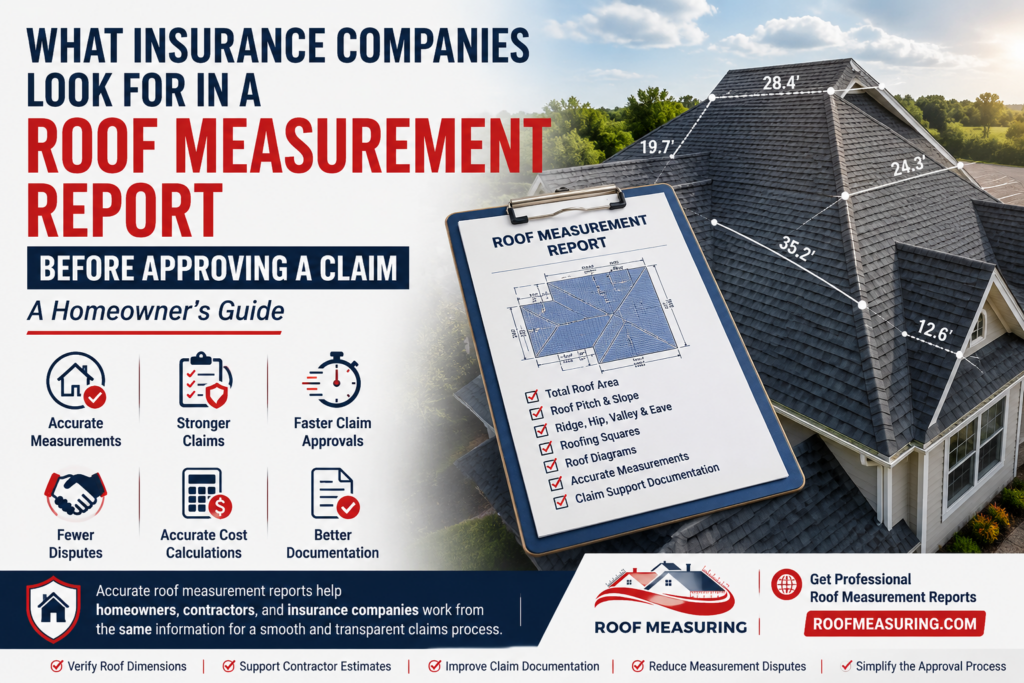
A complete roof measurement report includes linear measurements of every major component:
- Ridges – Horizontal peaks at the top
- Hips – Sloped corner lines
- Valleys – Internal angles where sections meet
- Eaves & Rakes – Lower and side edges
These measurements affect material usage and installation costs. Adjusters cross-check them against contractor proposals to verify the scope of work.
4. Roofing Squares
Roofing projects are priced in roofing squares where 1 square equals 100 sq ft.
The number of squares in your contractor’s estimate must match your aerial roof measurement report. Any mismatch raises a red flag and can delay your insurance roof claim.
5. Damage Documentation Support
A roof measurement report strengthens your full claim file when combined with photos, inspection reports, and contractor assessments.
It supports:
- Storm, hail, and wind damage claims
- Full roof replacement claims
- Insurance estimate reviews
The more complete your documentation, the smoother your insurance roof claim review.
Common Reasons Roofing Claims Get Delayed
Most delays come down to incomplete or inconsistent data:
| Issue | Impact |
|---|---|
| Incorrect measurements | Estimate mismatches |
| Missing roof diagrams | Adjuster can’t verify scope |
| Inaccurate roofing squares | Cost discrepancies |
| Conflicting contractor quotes | Extended review time |
A professional roof measurement report eliminates these issues before they slow down your claim. For more guidance, visit the Insurance Information Institute’s homeowners claim guide or FEMA’s storm damage resources.
What to Do Before Filing Your Claim {#tips}
- Document damage with photos immediately after the storm
- Get a professional roof measurement report before submitting estimates
- Hire a licensed contractor for a written inspection report
- Review your policy for coverage limits and deductibles
- Submit a complete claim file — measurements, photos, and contractor assessment
Starting with accurate aerial roof measurement data gives you a stronger foundation for a faster, smoother approval.
The Bottom Line
Insurance companies approve claims based on verified data. A professional roof measurement report supports accurate estimates, reduces disputes, and helps your insurance roof claim move forward with confidence.
Visit roofmeasuring.com to get a detailed roof measurement report that supports your claim from day one.