When you are estimating for a roofing task, precise estimating can save or cost your budget. If you overestimate, you can waste material and money; if you underestimate, you will have a shortage that can be costly and create delays. In the roofing industry, knowing how to accurately estimate roofing squares is a necessary skill for all roofers, contractors, and homeowners.
In this comprehensive guide, we will share with you 7 power tips to help you accurately estimate your roofing squares with the objective of minimizing waste, maximizing efficiency, and keeping profit margins high on every project.
Table of Contents
What Is a Roofing Square?
A roofing square is the measurement that is commonly used when working on roofing. One roofing square equals 100 square feet of rooftop area. Using a square helps ease the process of estimating roofing materials since products like shingles, underlayment, and every other material, will likely be measured and sold based on squares.
For example, if the area of a roof is 2,000 square feet, it would be 20 roofing squares. Learning how to estimate roofing squares will help you order accurate materials and plan the scope of a professional roofing project.
1. Measure Roof Dimensions Correctly
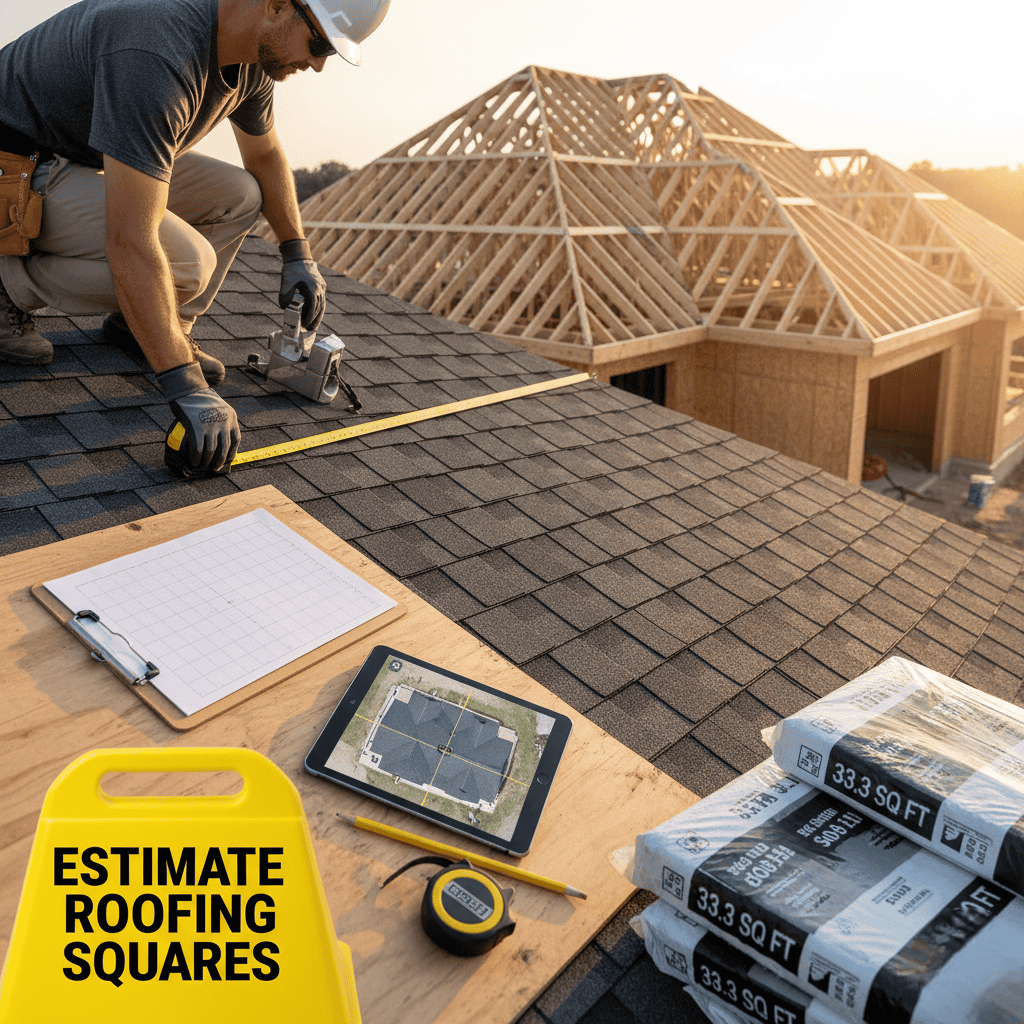
Accurately calculating roofing squares begins with measuring length and width of your roof. Most roofs have different shapes; therefore, you should measure each section individually.
- Separate your roof into sections (gables, hips, valleys).
- Measure the length and width of each section.
- Multiply length multiplied by width to get a square footage for each section.
- Add the total square footages of each section together to get the overall roof area.
Then, divide by 100 for your total roofing squares.
Equation: Total Roof Area (sq ft) ÷ 100 = Roofing Squares
2. Account for Roof Pitch
Roof pitch significantly affects the actual surface area. A steep roof has more surface area than a flat one. Ignoring pitch leads to inaccurate roofing square estimates.
| Roof Pitch | Pitch Multiplier |
|---|---|
| 3/12 | 1.03 |
| 4/12 | 1.05 |
| 5/12 | 1.08 |
| 6/12 | 1.12 |
| 7/12 | 1.16 |
| 8/12 | 1.20 |
| 9/12 | 1.25 |
| 10/12 | 1.30 |
After calculating your flat roof area, multiply it by the pitch multiplier to get the true roof area.
Example: A 2,000 sq ft roof with a 6/12 pitch → 2,000 × 1.12 = 2,240 sq ft = 22.4 roofing squares
3. Use Aerial and Satellite Roof Measurement Reports
Manual measurements can be hazardous and inefficient. Today’s dependable roofers use aerial and satellite roof measurement reports to achieve better accuracy.
They take measurements using high-resolution imagery and 3D imaging:
- Total roof area
- Pitch/slope
- Edge lengths
- Ridge and valleys measurements
- Waste factor recommendations
These tools allow you to estimate roofing squares accurately from the ground level without a ladder and reduce your time spent on the roof while increasing your safety!
Aerial imaging services, like RoofMeasuring.com, provide contractors across the USA and Canada, reliable and quick turnarounds for hard copy CAD-style report.
4. Factor in Waste Percentage
All roofing jobs produce waste in the following areas:
- Starter shingles, ridge caps
- Valleys, hips, and cuts
- Roof shape irregularities
A good rule of thumb for waste is about 10–15%, depending on how intricate the roof is.
Pro Tip:
- Feedback simple roofs – add 10% waste
- Feedback complex roofs – 15–20% waste
If you don’t account for waste, you may run out of materials and delay your installation schedule.
5. Include Overhangs, Dormers, and Extensions
Keep in mind that the roof extends beyond the walls of the house when estimating roofing squares. The parts of the roof that extend over an edge, or any dormers and other roof extensions, should be considered for additional area.
Measure eaves and overhangs, and in most cases, add a foot on each edge to your measurements. Also, include smaller areas for bay windows or a roof over a porch, etc.—these can add to the amount of material needed.
6. Verify Roof Type and Material Coverage
Different roofing materials have different coverage rates per square. Knowing what type of material you’re installing ensures your roofing square estimate matches the actual material requirement.
| Material | Coverage per Square | Notes |
|---|---|---|
| Asphalt Shingles | 100 sq ft | Standard 3 bundles per square |
| Metal Roofing | 100–120 sq ft | Depends on panel width |
| Wood Shakes | 90–100 sq ft | Add extra for trimming |
| Clay/Concrete Tiles | 90–110 sq ft | Heavier roofs need underlayment adjustments |
7. Double-Check Your Calculations with Software or Reports
Mistakes can occur— even if you have a great deal of experience. Always cross-reference your estimate of squares of roofing area using reputable software or measuring reports.
Many modern estimating applications incorporate aerial photography and CAD data to help you automatically determine:
- Total squares
- Pitch multipliers
- Waste adjustments
- Ridge and hip dimensions
Using modern estimating applications is available to ensure you order the precise amount of material each time to eliminate unwanted material purchases, saving you money and saving time on the job.
Bonus Tip: Simplify Your Estimates with Professional Reports
If you want accurate results, use professional roof measurements that provide ready-to-use reports. They include detailed diagrams, square breakdowns, pitch information, and are ideal for:
- Roofers and contractors for estimating projects
- Insurance adjusters to validate insurance claims
- Homeowners who are planning replacements
This will not only help improve your accuracy, but also help improve your professional image when presenting proposals to clients.
Why Accurate Roofing Square Estimation Matters
Providing accurate estimates safeguards your profits and earns your potential clients’ respect. Roofing contractors who provide accurate and consistent estimates are perceived as professionals who are reliable and can protect their clients from costly unwelcome surprises during the installation process.
The benefits of providing accurate estimates consist of:
- Less material waste
- Polished projects turnover
- Increased customer satisfaction
- Improved credibility and more repeat business
From simple square on a roofing project, when you can estimate squares like a professional you are measuring roofing, and your business, differently.
FAQs on Estimating Roofing Squares
1. What is the simplest approach for estimating roofing squares?
The simplest approach for estimating roofing squares is to use either aerial roof measurement reports or roof estimating software. Both of these tools automatically add up the roof area, roof pitch, and waste, so you won’t have to worry about any manual errors.
2. How many square feet is in one roofing square?
One roofing square is equal to 100 square feet of roof surface area. For example, if the roof is 2000 sq. ft. this would equal 20 roofing squares.
3. What amount of waste should I incorporate into my roofing estimate?
On average, the waste should be 10-15% depending on the complexity of the roof. Simple gable roofs may only require 10%, and more complex roofs with hips and valleys may require from 15-20% waste.
4. How do I measure roofing squares for a steep roof?
For steep roofs, you have to apply a pitch multiplier to your flat roof size. For instance, a 6/12 pitched roof would use a multiplier of 1.12. Take your total flat size and multiply it by the multiplier to the get the actual square footage for the roof, then divide it by 100 for total squares.
5. Why should I use satellite or aerial roof measurement services?
Using satellite or aerial reports takes the guesswork out of measuring roofs since you don’t have to go on the roof. They will save you time, which = safety, and they come with slope, ridgeline, waste recommendations, etc. A satellite or aerial report are great tools for helping a roofer get fast, accurate, and reliable estimates for anything.
Final Thoughts
It is important that any roofing contractor or estimator learns how to accurately estimate roofing squares. When you measure accurately, calculate the roof pitch, consider waste, and order an aerial report, you can provide professionals that are exact an professional.
The reason accurate estimates are key to any roofing project is because it will save you time, money and materials. Regardless if you are a seasoned roofer, or you are a contractor just starting out, by following these 7 power tips, every job can begin with accuracy, confidence, and a professional experience.
FAQs on Estimating Roofing Squares
1. What is the simplest approach for estimating roofing squares?
The simplest approach for estimating roofing squares is to use either aerial roof measurement reports or roof estimating software. Both of these tools automatically add up the roof area, roof pitch, and waste, so you won’t have to worry about any manual errors.
2. How many square feet is in one roofing square?
One roofing square is equal to 100 square feet of roof surface area. For example, if the roof is 2000 sq. ft. this would equal 20 roofing squares.
3. What amount of waste should I incorporate into my roofing estimate?
On average, the waste should be 10-15% depending on the complexity of the roof. Simple gable roofs may only require 10%, and more complex roofs with hips and valleys may require from 15-20% waste.
4. How do I measure roofing squares for a steep roof?
For steep roofs, you have to apply a pitch multiplier to your flat roof size. For instance, a 6/12 pitched roof would use a multiplier of 1.12. Take your total flat size and multiply it by the multiplier to the get the actual square footage for the roof, then divide it by 100 for total squares.
5. Why should I use satellite or aerial roof measurement services?
Using satellite or aerial reports takes the guesswork out of measuring roofs since you don’t have to go on the roof. They will save you time, which = safety, and they come with slope, ridgeline, waste recommendations, etc. A satellite or aerial report are great tools for helping a roofer get fast, accurate, and reliable estimates for anything.