Table of Contents
A roof pitch chart is a reliable method of measuring and communicating how slopes, or pitches, are measured on buildings. Professionals in the construction, architectural, and roofing fields will use precise pitch data to assure structural integrity, provide for proper drainage, use compatible materials, and prepare accurate estimates of costs. When professionals use a pitch chart to assess and measure a roof’s slope, they can remove the need for guesswork and provide a uniform method for measuring and communicating roof slopes throughout residential, commercial, and industrial buildings.
The slope of a roof determines the materials used in its construction, as well as the complexity of the installation and any long-term safety issues associated with the roof. As this guide explains, the correct calculation of the roof pitch and how to make the most of roof pitch charts simplifies and streamlines the roofing process.
What Is Roof Pitch and Why It Matters
The roof pitch indicates the angle of the roof and is stated as a ratio of the rise to the run. The ratio is generally written as X:12, which indicates that for every 12 inches of run, the roof rises X inches.
Knowing the exact roof pitch is important because it will affect:
- How efficiently water and snow drain from the roof
- What types of roofing material are appropriate
- How loads are distributed on the building’s structure
- What installation procedures and safety considerations need to be accounted for
- If the project meets the local building codes
Using a roof pitch chart, we quickly convert pitch values into degrees, percentages, and angles without manual calculations.
Standard Roof Pitch Chart Explained
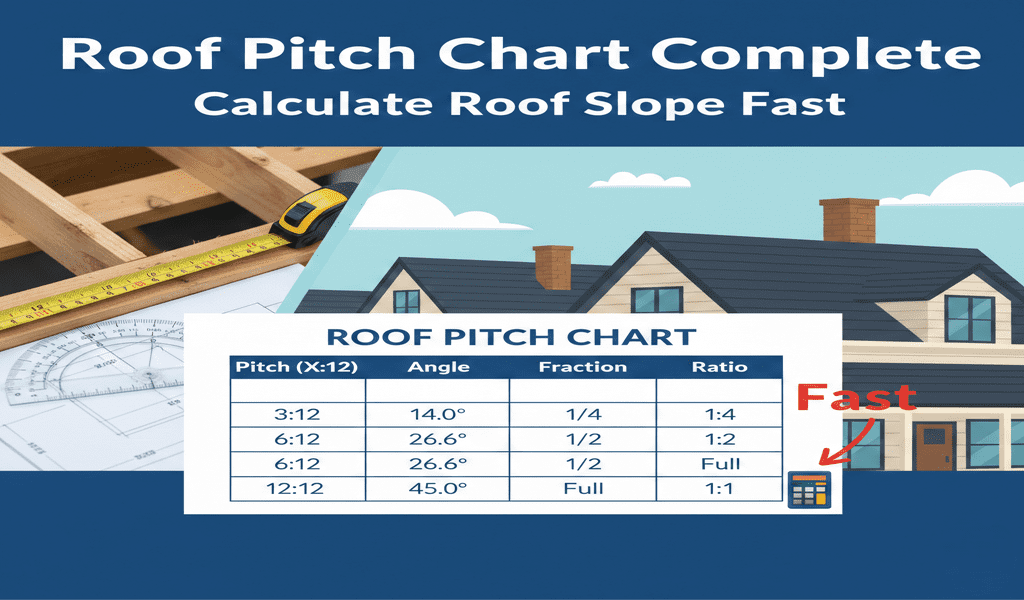
A professional roof pitch chart presents roof slopes in multiple formats to ensure universal understanding. Below is a commonly used reference format:
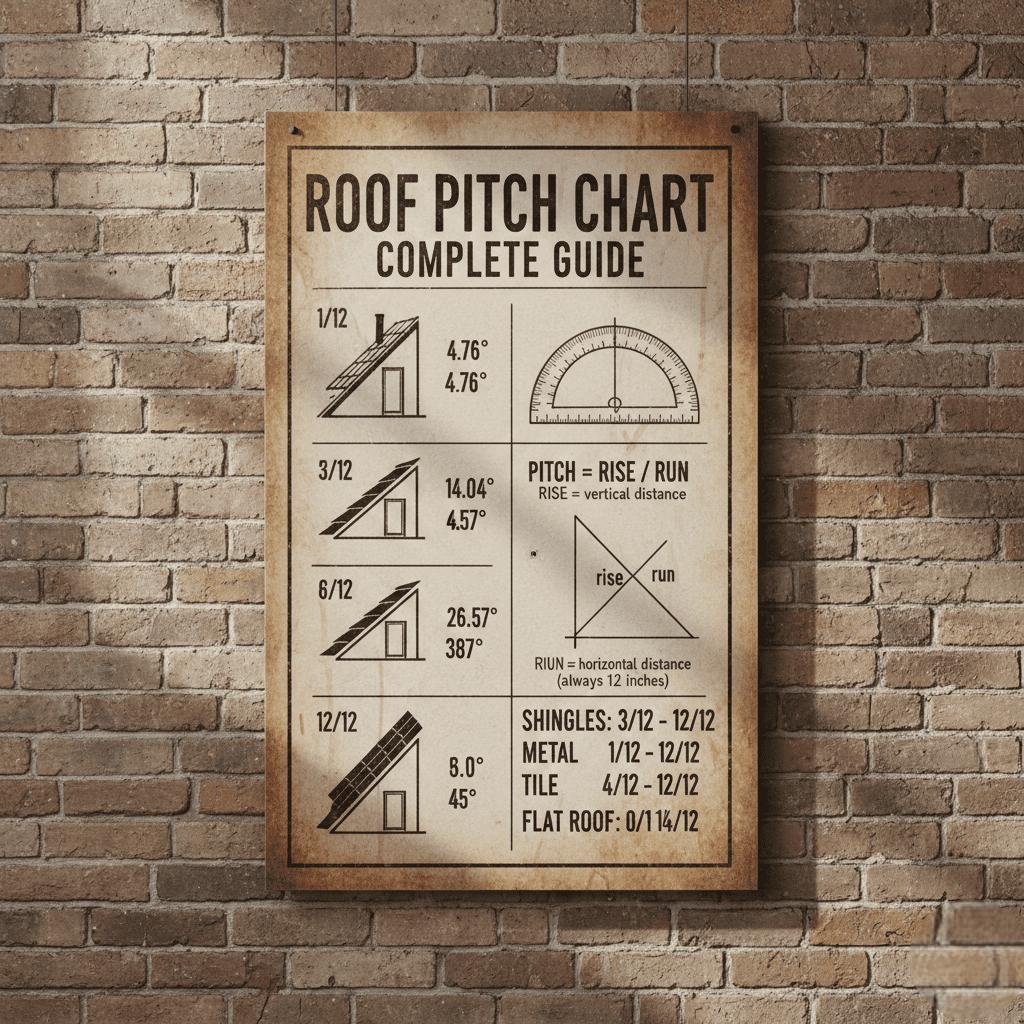
| Roof Pitch (X:12) | Slope (%) | Angle (Degrees) |
|---|---|---|
| 1:12 | 8.33% | 4.76° |
| 2:12 | 16.67% | 9.46° |
| 3:12 | 25.00% | 14.04° |
| 4:12 | 33.33% | 18.43° |
| 5:12 | 41.67% | 22.62° |
| 6:12 | 50.00% | 26.57° |
| 7:12 | 58.33% | 30.26° |
| 8:12 | 66.67% | 33.69° |
| 9:12 | 75.00% | 36.87° |
| 10:12 | 83.33% | 39.81° |
| 12:12 | 100% | 45.00° |
This chart allows contractors, estimators, and engineers to instantly interpret roof steepness in the most relevant unit.
How to Calculate Roof Pitch Using a Roof Pitch Chart
To find a roof’s slope using a roof pitch chart:
1) Measure 12″ of horizontal run on the roof.
2) Measure vertical rise from that point.
3) Look for the matching rise value on the roof pitch chart.
For example, if the rise is 6″ over the 12″ of run, the roof pitch will be 6:12, which converts to an angle of 26.57 degrees or a slope of 50%.
With this chart, you can find the pitch of any roof without having to use trigonometric calculations or any complex formulas.
Roof Pitch Chart vs Roof Slope Percentage
Roofing professionals typically use slope percentage and pitch ratio in roofing and carpentry applications, but they may also rely on a degree system for safety and architectural planning. A roof pitch chart can help bridge the gap between these two methods.
- Pitch ratios (X:12) are the most common measurement used within the roofing and carpentry industries.
- Slope percentages are used extensively within the engineering and drainage design industries.
- The degree system is critical for all types of architectural drawings and safety planning.
This chart shows all three formats gives you the ability to transfer information easily between members of your team.
Common Roof Pitch Categories
A roof pitch chart is used to categorize roofing into three basic categories:
Low-Slope Roofs
- Roof pitch from 1:12 to 3:12
- Typical for new commercial and residential buildings.
- They require a specially manufactured waterproof membrane.
Conventional-Slope Roofs
- Roof pitch from 4:12 to 9:12
- Most residential homes are built with a conventional slope.
- Compatible with both asphalt shingles, metal roof panels, and tile roofing types.
- Roof pitch above 10:12
Steep-Slope Roofs
- Drainage is much improved; also provides aesthetic benefits.
- These roofs are more complicated to install and require more stringent safety standards.
Understanding the roof pitch chart categories will assist with selecting appropriate products and systems for installation on roofs.
Roof Pitch Chart and Roofing Material Compatibility
All roofing materials have a maximum and minimum allowable pitch. A Roof Pitch Chart allows a contractor to install the material according to Manufacturer Specification Guidelines.
- Asphalt Shingles have a Minimum Pitch of 2:12
- Metal Roofing can have a Minimum Pitch from 1:12 to 3:12, depending upon profile
- Clay and Concrete Tile has a Minimum Pitch of 4:12
- Slate Roof has a Minimum Pitch of 4:12
- Flat Roofing Membranes have a Maximum Pitch of 2:12 or lower
This chart helps to avoid installation failures and warranty claims against the contractor because proper installation according to Manufacturer Specifications has taken place.
Roof Pitch Chart for Estimation and Cost Accuracy
Roof pitch data is crucial as it dictates the amount of materials and man-hours required to complete a project. it provides a method for taking measurements of the roof area obtained from the plans and establishing an accurate roof area by using the correct pitch factor.
Steeper-pitched roofs will have:
- Increased material needs
- Longer labour times
- More technical safety requirements
Estimators use this chart to determine the exact multipliers for steeply pitched roofs, enabling them to provide corresponding accurate bids and minimize lost profits.
Digital Roof Pitch Charts and Online Tools
Today’s roofing workflow combines aerial measurement with estimating software in order to create a digital roof pitch chart that will determine slope, pitch, and total area to be roofed based on satellite images.
With a digital chart, the following improvements are made:
- Quicker estimates
- Consistency in measurements
- Planning projects without going to the customer site
- Decreased risk of human error
In order to effectively grow a professional roofing operation, these digital pitch charts must be utilized for consistency and accuracy in all roofing project estimates.
Roof Pitch Chart and Building Code Compliance
Building codes for both local and national governments have requirements for minimum slopes on roofs. it allows you to verify compliance at any time during the planning phase or an inspection, and to identify issues while assisting in the planning of a project.
When contractors do not meet the required pitches, there are several consequences, including:
- Leakage
- Failure of structural elements
- Failing an inspection
- Increased costs through additional rework
In addition, using the roof pitch chart allows for peace of mind for both the contractor and property owner.
Advanced Applications of Roof Pitch Charts
In addition to use with roofing, it can serve as an important tool for:
- Optimizing the angle for solar panels
- Calculating snow loads
- Designing rainwater harvesting systems
- Developing an attic ventilation plan
With accurate information regarding the pitch of roofs, buildings can operate more efficiently by being able to maximise performance and energy consumption.
Professional Best Practices for Using Roof Pitch Charts
It is recommended that for the best accuracy, you will:
- Confirm the pitch of the roof in several sections;
- Use a digital inclinometer and chart;
- Record the pitch in the Project Documentation;
- Verify compatibility of materials prior to ordering.
When used correctly, a roof pitch chart is a foundational tool for every roofing project that is completed successfully.
Conclusion
Roof pitch charts provide the roofing professional with an accurate way to determine and measure roof slopes. They also help to ensure compliance with local codes and regulations, as well as to improve efficiency and roof lifespan. By knowing how to read, utilize, and compute roof pitch, roofing professionals can improve their overall roofing processes and quality of work. Whether you are estimating, installing, or designing a roofing system, having a comprehensive pitch chart is critical to obtaining accurate and reliable results.
FAQs:-
1. What is a roof pitch chart?
A roof pitch chart is a reference guide used by contractors to quickly determine a roof’s slope based on both its ratio (slope), angle, and percentage so that they may accurately calculate the Steepness of a roof.
2. How do you read a roof pitch chart?
To read a roof pitch chart, locate the vertical rise of a roof over the 12-inch horizontal Run. Once you have located your vertical rise, find the corresponding roof slope angle and percentage.
3. What is the most common roof pitch for homes?
The most common Residential Roof Pitch ranges from 4:12 to 6:12. This Roof Pitch gives the user the best balance between drainage, durability and ease of installation with standard roofing materials.
4. Can a roof pitch chart help calculate roof slope?
Yes! Roof Pitch Charts will instantly convert all pitch ratios into degree and percentage format, enabling quick and easy calculations of a roof’s slope with very few errors.
5. Why is a roof pitch chart important for roofing projects?
Roof Pitch Charts help to make sure you select the proper roofing materials, accurately estimate the project, provide for proper drainage, and comply with local building codes.