The decision between a roof replacement and a roof repair is one of the most expensive calls a homeowner will ever make. Get it wrong in either direction and you either spend $15,000 on a new roof you didn’t need, or patch a roof that fails two years later anyway. Here’s how accurate roof measurement data removes the guesswork and gives you the right answer the first time.
The Question Every Homeowner Dreads — and Most Contractors Can’t Answer Precisely
You notice a leak. Or a neighbor mentions your shingles look rough. Or you just had a hailstorm roll through. You call a roofing contractor, they walk around the property, peer at the roof from the driveway, maybe climb up and poke at a few shingles and then they give you a number.
The problem is, that number is often based on a visual assessment, not verified measurement data. And a visual assessment alone misses a critical dimension: the true extent of the damage relative to the total roof surface area.
This is where most homeowners end up in one of two costly situations:
- Overpaying — a contractor recommends full replacement when targeted repairs would have been perfectly sufficient
- Underpaying now, overpaying later — a cheap patch job fails within 18 months because the underlying damage was more widespread than anyone measured
The only reliable way to answer the replacement vs. repair question accurately is with a professional roof measurement report that quantifies the damage area against the total roof square footage. Everything else is an educated guess.
The core rule: If damaged or deteriorated roofing material covers more than 25–30% of your total roof surface area, most roofing professionals and insurance carriers will recommend full replacement over repair. But without measurement data, no one can tell you that number with confidence.
Why the 25% Threshold Rule Depends Entirely on Accurate Roof Measurements
The “25% rule” is one of the most widely referenced benchmarks in roofing the general principle that once damage reaches roughly a quarter of the total roof surface, replacement becomes more cost-effective than piecemeal repair. Some insurance carriers use a 30% threshold. Others use different metrics based on roof age and material type.
But here’s what nobody tells you: this rule is completely meaningless without an accurate measurement of your total roof area.
Consider two homes that look similar from the street. One has a straightforward gable roof with 1,800 square feet of surface area. The other has dormers, a garage addition, and multiple pitch changes and actually covers 2,900 square feet. A visual inspection won’t reveal that difference. A professional roof measurement report will.
25–30%Damage threshold where replacement beats repair on cost
$400–$800Average cost of a professional roof measurement report
$8,000+Average cost of an unnecessary full roof replacement
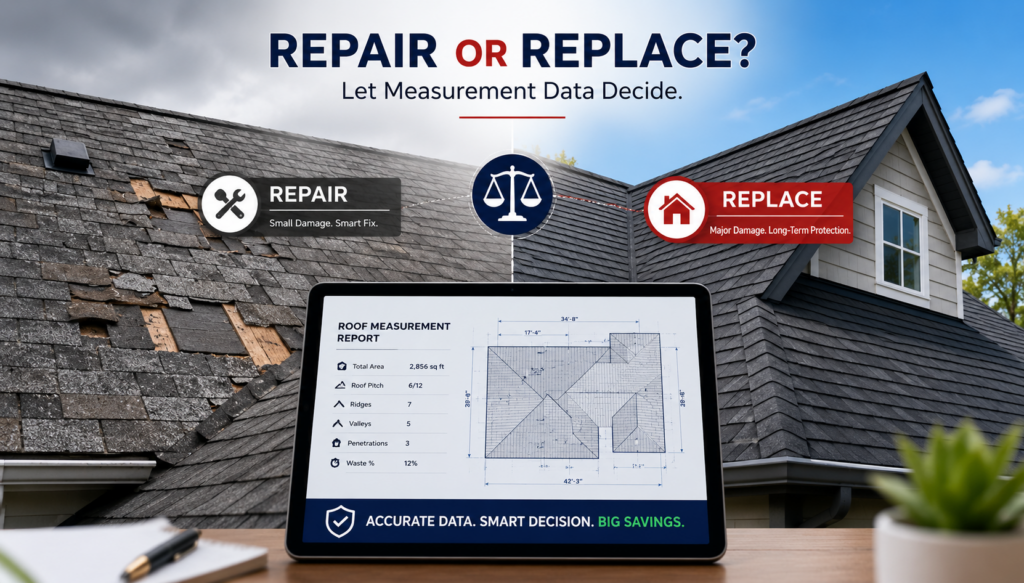
A roof measurement report from a professional service gives you the exact total roof squares, surface area by section, pitch data for every plane, and ridge, hip, valley, and eave measurements. With that data in hand, any roofing contractor can calculate the precise damage percentage and give you a recommendation that’s based on math, not intuition.
What a Professional Roof Measurement Report Reveals That a Visual Inspection Misses
Visual inspections are valuable. But they have a hard ceiling. A trained roofer on your property can identify visible damage missing shingles, surface granule loss, obvious cracking or curling. What they can’t do standing on a ladder is tell you with precision how many roofing squares of material are compromised versus still structurally sound.
A professional roof measurement report delivers data that directly informs the replacement vs. repair decision:
| Data Point in the Report | How It Informs the Repair vs. Replace Decision |
|---|---|
| Total Roof Area (sq ft) | The baseline against which all damage percentages are calculated |
| Roof Squares per Section | Identifies which planes are damaged vs. intact critical for partial repairs |
| Roof Pitch & Slope | Steeper pitches have higher labor costs affects the repair vs. replace ROI calculation |
| Ridge & Hip Lengths | Ridge damage is disproportionately expensive to repair measurement reveals true scope |
| Valley Lengths | Valleys concentrate water flow damage here accelerates total roof deterioration faster |
| Roof Diagram Report | Visual plane-by-plane layout that lets you map which sections need work |
| Waste Factor Calculation | Determines true material cost for both repair AND replacement options |
When you have this data, the roof replacement vs. repair conversation changes entirely. Instead of taking a contractor’s word on a recommendation that could vary by thousands of dollars depending on who you ask, you have a document that any contractor, adjuster, or second opinion can review and validate.
5 Specific Scenarios Where Measurement Data Makes the Decision Clear
Scenario 1: Hail Damage After a Storm
After a hailstorm, the visible damage on the street level dented gutters, bruised shingles rarely reflects the full picture. Hail impact density varies across a roof depending on slope angle, orientation, and exposure. A roof measurement report maps total surface area so an adjuster or contractor can document damage coverage with precision, not approximation. This is the difference between a justified full replacement claim and a partial repair settlement that leaves the roof compromised.
Scenario 2: An Aging Roof With Isolated Leaks
A 17-year-old asphalt shingle roof develops two leaks over one winter. The question isn’t just “can we patch these?” it’s “how much of this roof’s surface area is still at or near end of life?” If roof measurement data reveals the roof covers 28 squares across multiple pitch planes, and the compromised sections represent 8 of those squares, you’re at a 28% deterioration threshold. A targeted repair now buys limited time. The measurement data makes that case quantifiably, not just intuitively.
Scenario 3: Pre-Sale Home Inspection
A buyer’s home inspector flags potential roof issues. The seller has two options guess at a repair or produce a professional roof measurement report that documents exactly what areas show wear and what the total surface condition looks like. Sellers who provide measurement-backed documentation move faster through negotiations, avoid arbitrary repair credits, and give buyers the confidence that the decision was data-driven.
Scenario 4: Wind Damage on One Side of the Roof
Wind damage is frequently asymmetric hitting the side of the roof facing the storm direction while leaving the opposite slope largely intact. Without measurement data, a contractor estimating repair could either miss hidden damage on adjacent planes or over-recommend by quoting the whole roof. A roof measurement report that breaks down square footage by plane makes it possible to isolate exactly what needs replacing and what doesn’t.
Scenario 5: Insurance Claim Filing
Insurance carriers are increasingly requiring measurement-backed documentation before approving roof replacement claims. Submitting a claim supported by a verified aerial roof measurement report with exact square footage, pitch data, and a labeled diagram removes the ambiguity that causes delays, reinspection, and lower-than-justified settlements. Contractors who submit measurement data with their estimates on behalf of clients report faster approvals and fewer adjuster disputes.
The Real Cost Comparison: Repair vs. Replacement Done Right
Cost estimates for roofing without measurement data are notoriously unreliable. Here’s what accurate roof measurement data does to the numbers:
✅ When Measurement Data Points to REPAIR
- Damage is isolated to one or two roof planes and covers less than 20% of total surface area
- The roof is less than 12–15 years old with no widespread granule loss or structural compromise
- Valley and ridge lines show no damage — just field shingles on one slope
- Pitch data shows a walkable slope — repair labor cost is proportionate, not excessive
- Waste factor on the damaged section is low — material cost for repair is a fraction of full replacement
Typical repair cost range: $500 – $3,500 depending on damage scope and material
⚠️ When Measurement Data Points to REPLACEMENT
- Damage or significant wear covers 25% or more of total roof square footage
- Roof age exceeds 20 years — even undamaged sections are approaching end of service life
- Multiple pitch planes show granule loss, cracking, or curling — systemic deterioration, not isolated events
- Valley and ridge measurements reveal damage at the most water-vulnerable points
- Repair cost per section, when added up across multiple planes, approaches 60–70% of total replacement cost
Typical replacement cost range: $8,000 – $25,000+ depending on roof size, pitch, and material
The critical point: without accurate roof measurements, neither the contractor nor the homeowner can reliably calculate what percentage of these cost thresholds applies to their specific situation. A contractor giving you a replacement recommendation on a 1,400 sq ft ranch home is giving you a very different risk profile than the same recommendation on a 3,200 sq ft colonial with multiple dormers and valleys — even if both look similar from the driveway.
How Roofing Contractors Use Measurement Data to Give Better Repair vs. Replacement Recommendations
The best roofing contractors in competitive markets don’t rely on visual estimates alone. They order a professional roof measurement report before committing to a repair vs. replacement recommendation and they use that data to have a more honest, credible conversation with the homeowner.
This approach does three things that transform the contractor-homeowner relationship:
- It builds immediate trust. A homeowner who sees verified square footage data, a labeled roof diagram, and precise pitch measurements knows they’re dealing with a contractor who does their homework. This separates professional operations from fly-by-night outfits offering suspiciously fast quotes.
- It eliminates the “I got three different quotes” problem. When a homeowner gets wildly different quotes from three contractors, it’s almost always because each contractor used different assumptions about roof size, pitch complexity, and damage scope. One measurement report standardizes the data and makes your estimate the one that’s grounded in verified numbers.
- It protects the contractor from liability. A repair recommendation made without measurement data leaves the contractor exposed if the roof fails prematurely. A recommendation documented with a full roof measurement report shows the contractor did their due diligence. The data existed. The recommendation was defensible.
Industry insight: Contractors who present roof measurement reports alongside their estimates close jobs at significantly higher rates not because they’re the cheapest, but because homeowners associate documented data with professionalism and trust. The report isn’t just a measurement tool. It’s a sales tool.
What to Look For in a Roof Measurement Report When Making the Repair vs. Replace Call
Not all roof measurement reports are created equal. When using a report specifically to make the replacement vs. repair decision, ensure it includes:
- ✅ Total roof area in square feet AND roofing squares — both units matter for different parts of the calculation
- ✅ Breakdown by roof plane/section — you need to know which sections are damaged, not just the total
- ✅ Roof pitch per plane — pitch affects labor cost, which affects the repair vs. replace ROI
- ✅ Ridge, hip, valley, eave, and rake lengths — these determine the full scope of flashing and accessory material needs
- ✅ Visual roof diagram — a labeled overhead layout so you can map damage to specific sections
- ✅ Waste factor included — critical for accurate material cost in both scenarios
A professional roof measurement report from a trusted service delivers all of this, typically within hours of ordering, without requiring anyone to climb your roof, schedule a site visit, or wait days for a field team to become available.
The Homeowner’s Action Plan: How to Use Measurement Data Before You Decide
Here’s a practical step-by-step approach for any homeowner facing the roof replacement vs. roof repair decision:
- Order a roof measurement report first. Before calling contractors, before filing an insurance claim, before getting a single quote, order a professional roof measurement report. You’ll have total square footage, pitch data, and a full diagram within hours.
- Document the visible damage by section. Walk around your home after a storm or inspection and note which sides or sections show obvious damage. Cross-reference this against the measurement report’s plane-by-plane breakdown.
- Apply the 25% threshold. If you can estimate that the damaged sections cover 25% or more of your total roof area, or if a contractor confirms this with the measurement report in hand, replacement is likely the better financial decision.
- Get contractor quotes based on the report, not their own measurements. Give every contractor you consult the same measurement report. This standardizes the bidding process and ensures you’re comparing quotes for the same scope of work.
- Use the report in your insurance claim. If you’re filing a claim, submit the measurement report with the claim documentation. It significantly reduces adjuster back-and-forth and supports accurate damage valuation.
Frequently Asked Questions: Roof Replacement vs. Roof Repair
How do I know if I need a full roof replacement or just a repair?
The most reliable way to answer this is with a professional roof measurement report that documents your total roof area and allows a contractor to calculate what percentage is damaged or deteriorated. As a general rule, if more than 25–30% of your roof surface is compromised, replacement is typically more cost-effective than repair. Below 20%, targeted repair is usually the right call.
What is the average cost difference between roof repair and full replacement?
Most residential roof repairs range from $500 to $3,500 depending on the extent of damage and materials. A full roof replacement typically runs from $8,000 to $25,000 or more, depending on total roof square footage, pitch complexity, and material choice. Accurate measurement data ensures both estimates are based on the real size of your roof, not approximations.
Can a roof measurement report help with an insurance claim?
Yes, significantly. Insurance adjusters require documented evidence of damage extent relative to total roof area. A roof measurement report with verified square footage, pitch data, and a labeled diagram gives adjusters the data they need to process claims faster and more accurately, reducing the likelihood of underpayment or reinspection requests.
Does roof pitch affect whether I should repair or replace?
Yes. Steeper roofs are significantly more expensive to work on because of the additional labor, safety equipment, and time required. A roof measurement report includes pitch data for every plane, which means your contractor can calculate the true labor cost for repair vs. replacement on your specific roof, not a generic estimate.
How long does it take to get a roof measurement report?
Professional roof measurement reports from a dedicated service are typically delivered within hours of ordering, often the same day. There’s no need for a site visit, which means you can have verified measurement data before you’ve even scheduled a contractor consultation.
What’s the difference between a roof measurement report and a roof inspection?
A roof inspection is a physical assessment by a trained professional who evaluates the visible condition of materials, flashing, gutters, and structural integrity. A roof measurement report is a data document that provides verified square footage, pitch, ridge/hip/valley lengths, and a roof diagram. Both are valuable and together they give you the complete picture needed to make a confident roof replacement vs. repair decision.
Get the Data You Need to Make the Right Call
Stop guessing. A professional roof measurement report gives you verified square footage, pitch data, a full roof diagram, and everything a contractor or insurance adjuster needs to make the replacement vs. repair decision with confidence delivered in hours, not days. Order Your Roof Measurement Report Learn More About Our Report