Every roofing estimate is a promise built on numbers. Somewhere behind that quote is a claim about how big your roof is, how steep it sits, and how much material it will take to cover it properly. When those numbers are right, the promise holds. When they’re wrong, the promise breaks, usually after you’ve already signed the contract.
Most homeowners never see the math behind their roofing estimate. They see a final number on a page and assume someone, somewhere, climbed up there with a tape measure and worked it out properly. Sometimes that’s exactly what happened. Often, it isn’t. A surprising number of roofing quotes are built on rough visual guesses dressed up to look like precise calculations, and the only way most people find out is the expensive way: after the job is already underway.
The good news is that bad roof measurements almost always leave traces. They show up as small inconsistencies, missing details, and shortcuts that are easy to spot once you know where to look. This article walks through what those traces actually look like in practice, why they matter so much for your wallet, and what a properly measured roof report should contain instead.
| 60%+ of roofing disputes trace back to incorrect measurements | $3,000+ average overcharge from inflated square footage | 15 min time it takes to check a quote against a real report |
Why a Wrong Number at the Start Becomes an Expensive Problem Later
A roof isn’t priced the way most products are. There’s no fixed sticker price, because every roof is a different size, shape, and pitch. The entire estimate, materials, labor hours, disposal costs, waste allowance, is calculated from one starting figure: the measured area and shape of your specific roof. Get that number right, and everything built on top of it tends to hold together. Get it wrong, and the error doesn’t stay small. It multiplies through every line of the quote.
This is why a vague or guessed roofing estimate is rarely just a little bit off. If a contractor underestimates your roof’s true size by 15%, they’re not just short on material by 15%, they may also be short on the labor hours needed to install it, the flashing required for valleys they didn’t account for, and the disposal capacity needed for the old roofing they’re tearing off. One bad number at the foundation of the estimate becomes several compounding shortfalls by the time the crew is on your roof.
This is also exactly why insurance claims so often stall or get underpaid. Adjusters are trained to compare the measurements in a contractor’s estimate against independent data. If those numbers don’t line up, the claim doesn’t move forward smoothly, it gets questioned, delayed, or settled for less than it should be. A roof measurement problem you never noticed on the homeowner side can quietly cost you again on the insurance side.
What a Bad Measurement Actually Looks Like in the Real World
Picture a fairly ordinary scenario. A contractor pulls into the driveway, steps out, looks up at the roofline for a minute, walks the perimeter of the house once, and writes a number down on a clipboard. Twenty minutes later, you have a full written quote with a total price, a material list, and a signature line. It looks complete. It looks professional. But nothing about that twenty-minute process involved an actual measurement, just a trained guess based on what a similar-looking house usually requires.
Most of the time, that guess is in the right neighborhood. Experienced roofers develop a good eye over the years. But “in the right neighborhood” and “accurate” are two very different standards when you’re talking about thousands of dollars in materials and labor. A guess that’s off by a few hundred square feet, or that misses a steep secondary pitch around back, or that doesn’t account for three valleys instead of one, turns into a quote that simply doesn’t match the roof once work actually begins.
This is the moment where most homeowners encounter the consequences of bad measurement data, not at the quoting stage, but partway through the job, when a crew calls to say they need more shingles than expected, or when the final invoice includes a “material adjustment” line that wasn’t part of the original conversation.
Ten Signs That the Numbers Behind Your Quote Don’t Add Up
Once you know what to look for, a quote built on weak measurement data tends to give itself away fairly quickly. Here are the patterns worth paying attention to.
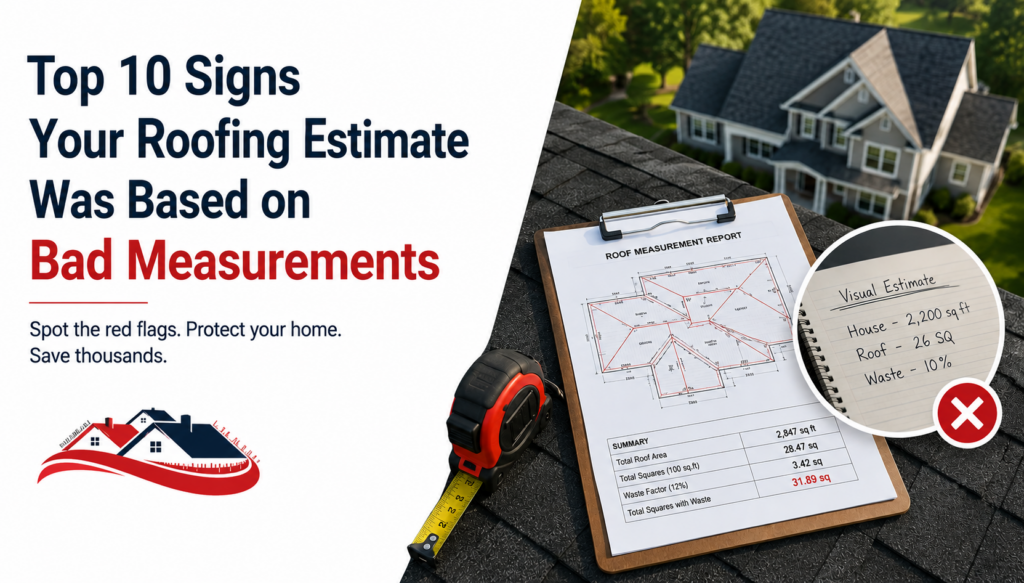
The first and clearest sign is the absence of a roof diagram. A properly measured roof comes with a visual, top-down layout showing each plane, ridge, hip, valley, and eave labeled individually. This diagram is the paper trail that proves a measurement actually happened. When a quote arrives as just a number with no supporting diagram, there’s nothing to verify, and usually nothing behind it either.
A second sign sits quietly in the total square footage itself. Real roofs are irregular shapes full of dormers, offsets, and varying pitches, which means an accurate measurement rarely lands on a clean, rounded figure. When every number on a quote is suspiciously tidy, 3,000 square feet exactly, for example, instead of something like 2,847, it’s often a sign that the figure was rounded from a guess rather than calculated from real roof measurement data.
A third and very telling sign appears when you collect more than one quote. If two contractors walk the same roof and come back with totals that differ by several hundred square feet, at least one of them is working from flawed data, and quite possibly both are. A properly measured roof shouldn’t produce wildly different totals depending on who’s doing the estimating.
The fourth sign is something many homeowners never think to ask about: pitch. The steepness of your roof changes labor difficulty, safety requirements, and material handling significantly, yet a surprising number of estimates never reference pitch at all. Treating a steep, complex roof exactly the same as a simple, walkable one in a quote suggests no one actually measured the slope, they assumed it.
Closely related is the fifth sign, speed without process. Genuine measurement work, whether it’s a careful manual walk of the roof or a professional aerial measurement report, takes time to gather and calculate. A full, signed quote produced within minutes of a brief driveway glance skipped a step somewhere, and that missing step is almost always the actual measuring.
The sixth sign lives inside the materials section of the quote: waste factor. This is the extra percentage of material ordered to account for cuts, overlaps, and roof complexity, and it should vary from house to house. A simple roof might only need a 10 percent allowance; a roof full of valleys and hips might need 20 percent or more. When a contractor applies the exact same flat percentage to every job they quote, regardless of the roof’s actual shape, it’s a sign the number is a habit, not a calculation.
The seventh sign is similar but more specific, the absence of individual ridge, hip, and valley lengths. These linear measurements determine how much flashing and specialty material your roof actually needs, and a properly measured roof measurement report lists them separately. A quote that lumps everything into one vague material total, with no breakdown of these individual lengths, is hiding the fact that they were never measured in the first place.
The eighth sign is the one that hurts the most, because by the time it appears, the contract is already signed. It’s the mid-project price increase, the call from the crew explaining that the roof turned out “bigger than expected” or needed more material than planned. A roof’s size doesn’t change between the quote and the installation. If the price does, the original measurement was wrong from the very beginning, and you’re only now finding out.
The ninth sign comes from an unexpected source: your insurance adjuster. Adjusters routinely check a contractor’s stated measurements against independent data before approving a claim. If your adjuster pushes back on the total area, the pitch, or the material quantities listed in your contractor’s estimate, that’s a professional, third-party confirmation that the original numbers don’t hold up under scrutiny.
The tenth and final sign is the simplest test of all, and the one every homeowner can use immediately. Ask the contractor directly whether you can see the measurement data behind the price. A contractor working from real numbers will have a roof measurement report ready to hand over, whether it came from a satellite measurement service, a drone flight, or a carefully documented manual walk. A contractor who hesitates, changes the subject, or admits the number is “just based on experience” is telling you, indirectly, that no real measurement exists behind their price.
Side by Side: What Separates Good Data from Bad Data
It helps to see these patterns laid out together. Here’s how the signs of a poorly measured estimate compare against what a properly measured one actually looks like.
| What You See | Sign of Bad Measurement | Sign of Accurate Measurement |
| Roof diagram | Missing entirely | Labeled, plane-by-plane diagram included |
| Total square footage | Suspiciously round number | Specific figure (e.g., 2,847 sq ft) |
| Multiple quotes | Vary by 500+ sq ft between contractors | Consistent within a small margin |
| Roof pitch | Never mentioned | Listed per roof plane |
| Time to produce quote | Instant, no real inspection | Based on a measurement report or thorough walk |
| Waste factor | Flat percentage, same on every job | Calculated based on actual roof complexity |
| Ridge / hip / valley data | Lumped into one number | Broken out individually |
| Mid-job changes | Price increases once work starts | Matches the original quote |
Protecting Yourself Before You Sign Anything
None of this requires you to become a roofing expert. It requires one thing: a measurement of your own, gathered independently, before you ever sit down to compare contractor quotes.
The simplest way to do this is to order an independent roof measurement report before requesting a single quote. This gives you a neutral baseline figure that no contractor can quietly inflate or shrink to fit their pricing. When the quotes start coming in, you compare every one of them against your own number instead of trusting each contractor’s word at face value.
From there, the rest of the process becomes far easier to manage. If a contractor’s stated square footage is wildly different from your own report, that’s your opening to ask why. If their quote never mentions pitch, ridge length, or valley measurements specific to your roof, you now know to ask for that detail directly instead of assuming it was considered. And if you’re in the middle of an insurance claim, attaching your own measurement report to the paperwork tends to remove a major source of dispute before it even starts, because the adjuster is working from the same verified numbers you are.
What makes this approach effective isn’t suspicion of every contractor you meet, most are honest, hardworking professionals. It’s simply removing the guesswork from a transaction where guesswork is expensive. A roof is one of the largest single expenses most homeowners ever pay for. The few minutes it takes to verify the numbers behind that expense is a small price for the certainty it buys.
| The One-Line Test If a contractor cannot show you the measurement data their price is based on, treat that number as a guess, not an estimate, until proven otherwise. |
The Bottom Line
A roofing estimate built on a guess can look exactly like one built on real data, until the job is underway and the numbers stop matching. The difference rarely announces itself loudly. It shows up in small details: a missing diagram, a suspiciously round number, a waste factor that never changes, a price that quietly grows once the crew arrives. Learning to spot these signs costs nothing and takes only a few minutes of attention. Not learning to spot them can cost thousands.
The fix is straightforward. Get your own measurement data before you ever compare quotes, and use it as the standard every contractor’s numbers have to match. It turns a process built on trust and guesswork into one built on verification, and it’s the single most effective way to make sure the price you agree to is the price you actually pay.
| Get a Verified Roof Measurement Report Before You Sign Anything Stop guessing whether your roofing quote is accurate. Order an independent roof measurement report with exact square footage, pitch data, and a full diagram, delivered in hours, so you can check every contractor’s numbers against the real ones. → roofmeasuring.com/ordernew |